
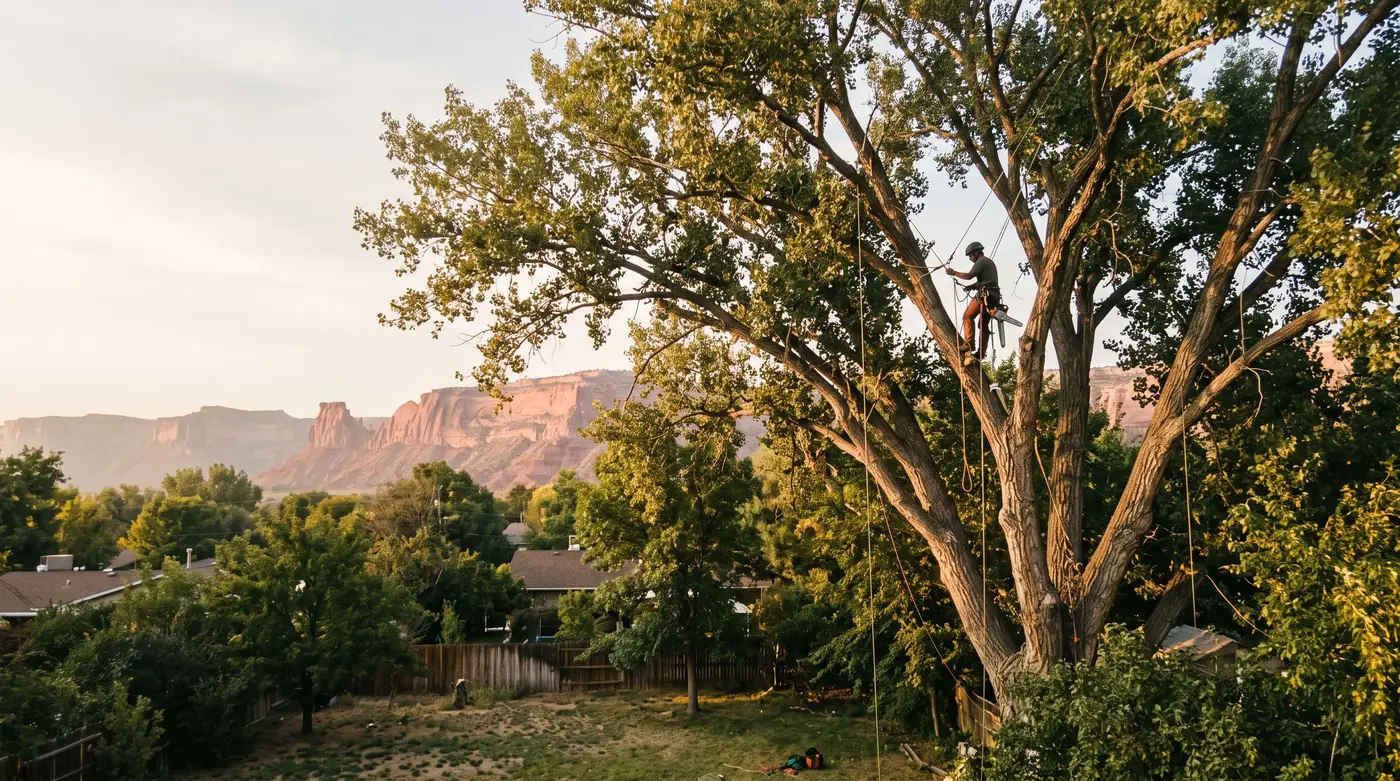
Wildfire mitigation in Mesa County, CO: Give your home a fighting chance
Defensible space is the ground around a home where fuels are cleared or reduced to slow a wildfire. The Colorado State Forest Service divides it into three zones, out to at least 100 feet, starting at the house and working outward. It improves the odds but guarantees nothing, and it needs ongoing upkeep.
The three zones
Start at the wall, work outward
From the CSFS Grand Junction Field Office and the Home Ignition Zone checklists. Do this around every building, including detached garages and sheds. Slopes need bigger zones, so ask CSFS about your site.
| Zone | Distance | What it means for trees and brush |
|---|---|---|
| Zone 1 | 0 to 5 feet | No large shrubs or trees and no flammable mulch. Rake needles and debris. If you keep a native tree, CSFS says to treat it as part of the structure and extend the zone around it |
| Zone 2 | 5 to 30 feet | Where most of the thinning happens. Small tree groups may stay with space between them. Remove ground junipers where you can, and keep shrubs 10 feet from tree branches |
| Zone 3 | 30 to 100 feet | Thin to keep fire on the ground and out of the canopy, and favor mixed ages and species. Work with neighbors if the distance crosses a property line |
The tree work
What a crew actually does
Most defensible space work is thinning, limbing and hauling. A crew removes dead trees and ladder fuels, the low branches and shrubs that carry fire up into crowns, and it deals with slash. CSFS warns that the job keeps going, because trees, grasses and shrubs keep growing, dying and dropping leaves every season.
- Keep slash and chip piles 30 feet or more from the home
- Leave gaps of at least 3 feet between chip accumulations
- Keep firewood 30 feet away, and uphill or level with buildings
- Clear flammable plants within 10 feet of propane tanks and gas meters
- Keep 10 feet between crowns and 30 feet back from each side of the driveway
- 1 mile+
- How far CSFS says embers can travel ahead of a fire
- 1/8 in
- Metal mesh CSFS suggests for attic and foundation vents
- 2027
- Last tax year of the state wildfire mitigation credit as CSFS describes it
- 970-248-7325
- CSFS Grand Junction Field Office, which covers Mesa County
HOA rules
Your HOA can only say so much
Under C.R.S. 38-33.3-106.5(1)(e), an HOA may not prohibit removing trees, shrubs or other vegetation for defensible space when the work follows a written plan from the Colorado State Forest Service, a locally certified planner or the fire authority, and removes no more than the plan calls for. Get the plan first. This is not legal advice, so read the statute or ask an attorney.
- 01
Get a plan
Call the CSFS Grand Junction Field Office, your fire district or a locally certified planner.
- 02
Tell your HOA
Share the plan early. The statute has its own conditions, including steps for the plan, so check them.
- 03
Check the rest
Power lines, canals and right-of-way trees still have their own rules. See our permit checker.
- 04
Get it priced
Ask for thinning, limbing and slash removal as separate lines, and plan a return visit.
New construction
County rules for new development
Our research on the Mesa County Land Development Code, as amended 4/23/2024, found section 8.07 encourages new development in woods or brush to follow a two-zone defensible space standard. The county has a code update hearing on 11-17-26, so check current text with Community Development. We found no such duty for existing yards.
Burning slash? Mesa County Public Health rules, seasons and fire restrictions apply. Check first at 970-248-6900. CSFS also warns that slash left in pinon and juniper can feed Ips beetle, so ask how yours will be handled.
Short answers
Wildfire questions, answered first
General information from the Colorado State Forest Service and state law. It is not a guarantee, and it is not legal or tax advice.
How far out does defensible space go?
The Colorado State Forest Service says at least 100 feet from buildings on relatively flat ground. That breaks into Zone 1 from 0 to 5 feet, Zone 2 from 5 to 30 feet and Zone 3 from 30 to 100 feet. Slopes call for more, and neighbors may need to help when it crosses a property line.
Should I remove every tree near my house?
No, though the first 5 feet should stay free of large shrubs and trees. CSFS says small groups can stay in Zone 2 with space between them, and a kept native tree in Zone 1 should be treated as part of the structure. Removing ground junipers and low ladder fuels usually matters a lot.
Can my HOA stop me from thinning trees for fire safety?
Not if the work follows a qualifying written defensible space plan, under Colorado law. C.R.S. 38-33.3-106.5(1)(e) names plans from the state forest service, a locally certified planner or the fire authority, and limits removal to what the plan needs. Read the statute, since it has conditions, and talk to your HOA first.
Is there a tax break for wildfire work?
CSFS describes a Colorado income tax credit for qualifying mitigation costs for tax years 2023 through 2027. Check the Colorado Department of Revenue guidance linked from the CSFS page, and ask a tax professional whether your spending qualifies. Keep invoices for the work. We have not confirmed amounts or limits, so we do not quote them.
Who can assess my property?
Start with the Colorado State Forest Service Grand Junction Field Office at 970-248-7325. It offers technical help with wildfire mitigation around homes and subdivisions across Mesa County and nearby counties. Your fire district may also help. A tree crew carries out the work, and it does not replace that advice or any written plan.
Sources
Where this came from
We read each page below on November 3, 2026, except the Land Development Code, which comes from our research notes. Follow your local fire authority over anything here.
- Protect Your Home and Property from Wildfire . Colorado State Forest Service.
Zones, structure ignition, ongoing upkeep and the tax credit.
Accessed - Home Ignition Zone Checklists . Colorado State Forest Service.
Slash, firewood, propane, driveway and chip spacing.
Accessed - Grand Junction Field Office: Wildfire Mitigation . Colorado State Forest Service.
Western Colorado zone details, junipers, embers and contact number.
Accessed - C.R.S. 38-33.3-106.5 . Colorado Revised Statutes, via Colorado Public Law.
Limits on HOA bans on defensible space work.
Accessed - Mesa County Land Development Code . Mesa County.
Section 8.07 for new development. Via our research notes.
Accessed - Burn Permits . Mesa County Public Health.
Burning rules and phone number.
Accessed
Send the details
Ready to clear some space?
Tell us what is around the house and whether you have a plan from CSFS or your fire district. A tree service professional can price the thinning and cleanup.
What happens next
- 1 Send the details What the tree is doing, where it is, and a photo or two if you have them.
- 2 We follow up You hear back the way you asked, with next steps.
- 3 Price in writing You see it before a saw starts, and the yes or no stays with you.
What helps us price it
- A photo of the whole tree and one of the problem
- Roughly how tall it is and how thick the trunk is
- What it could hit: a roof, a fence or power lines
- How a truck gets there, and how wide your gate is
- Whether you also want the stump ground and the wood hauled
If a tree is on a power line or anyone is hurt, call 911 or your electric utility first.
More tree services across the valley
Tree removal
Dead, leaning or too close to the house.
Tree trimming and pruning
Deadwood, heavy limbs and clearance.
Stump grinding
Ground below grade, ready to replant.
Storm and emergency tree service
Who to call first, and what comes next.
Tree health and disease
Yellow leaves, dead limbs, beetles and cankers.
Cabling and bracing
Support for a weak fork or a heavy limb.
Land clearing
Lots, brush, Russian olive and tamarisk.
Guides and tools: Grand Valley tree guide, Tree permit and HOA checker, Tree removal cost estimator, Storm alerts and damage help.